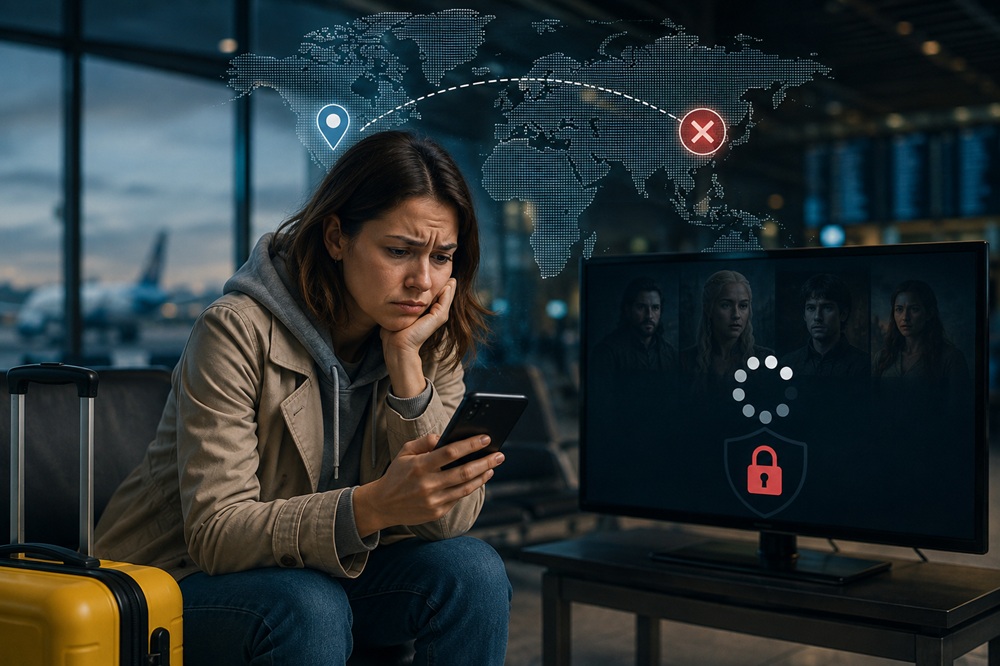
You arrive in another country, open the streaming app you use every week and discover that a programme has vanished. Sometimes the whole service looks different. In other cases, the app works but a particular film, sports event or series refuses to play. It can feel arbitrary, especially when the account is paid for and the device has not changed. The explanation usually has less to do with technology failing and more to do with how media rights are sold.
Streaming libraries are built around licensing territories
A streaming platform does not automatically own worldwide rights to everything in its catalogue. A studio might license a film to one service in the UK, another service in the United States and a traditional broadcaster in a third country. Sports rights can be even more fragmented, with separate agreements for domestic coverage, international feeds, highlights and mobile viewing. When you cross a border, the set of rights attached to your location can change.
That is why two people with the same brand of subscription can see different libraries. The service may have permission to show a title in one country but not another. Even when a platform produces its own content, older distribution agreements or co-production deals can create regional differences. Global technology sits on top of a media business that still negotiates many contracts country by country.
How a service knows where you are
The most obvious signal is the public IP address used by your internet connection. It can indicate the country or region from which you appear to be connecting. Services may combine that with other information such as account country, payment method, device settings or, on mobile devices, location permissions. The exact mix differs by platform and may change over time.
This location checking is not unique to entertainment. Websites use similar signals for language, local pricing, fraud prevention and regulatory compliance. For streaming companies, however, location is closely tied to whether they are licensed to deliver a particular programme. A playback restriction can therefore be an automated rights decision rather than a judgement about the individual customer.
Why live sport is especially complicated
Sport creates some of the most confusing restrictions because rights are frequently sold by competition, country and type of coverage. A streaming service may carry a league in one market while a local broadcaster owns it elsewhere. Blackout rules can also protect a broadcaster or venue agreement inside a specific area. As a result, a match available at home may be absent while travelling even though other parts of the streaming service work normally.
If you have ever searched for an explanation of why streaming blocked messages appear abroad, the key point is that the platform is usually enforcing the rights attached to your current location. That does not necessarily mean your account is broken. Checking the service’s official travel or portability policy is a sensible first step because some platforms explicitly allow temporary access in certain countries while others change the available catalogue.
Account region can matter as much as network location
People sometimes assume that changing internet connection is the only factor, but account-level details can also affect access. App-store country, billing address and the market in which the subscription was created may determine which plans or features are available. A service can also ask a household to verify a home location, particularly where account sharing is restricted.
Downloads add another layer. A programme downloaded before travel may continue working for a limited time, may require the device to reconnect periodically, or may become unavailable if the licence changes. Expiry rules can differ from normal streaming rules, so downloading content in advance is useful only when the platform permits travel playback under its own terms.
What travellers can do without guessing
- Check the platform’s official help pages for travel, portability and supported-country rules.
- Confirm that the subscription and payment details are current.
- Update the streaming app before travelling and sign in while you still have normal access.
- Download permitted content in advance when the service supports offline viewing.
- For live sport, check who owns the rights in the country you are visiting.
If a service produces an unexpected error, basic troubleshooting still matters. Restarting the app, checking for updates and testing another network can rule out ordinary technical problems. But when only certain titles disappear after crossing a border, licensing is a more likely explanation than a damaged device. Customer support can usually confirm whether a programme is available in the current region.
The internet is global; entertainment rights are not
Streaming created an expectation that a personal media library should follow us everywhere. Technically, delivering video across borders is easy. Commercially, the situation is much messier because films, series and sports are still bought and sold through regional contracts. Until those rights become more consistently global, travellers will continue to encounter different catalogues and occasional playback restrictions. Understanding that distinction makes the problem less mysterious, even if it does not make a missing episode any less annoying.